The Ultimate Twin Falls, Idaho Guide
What We’d Actually Do Again (and What We’d Skip)
Worth the Detour?
Our Verdict: Yes…for the right traveler. Twin Falls isn’t a destination we’d drive across the country to see on its own. But if you’re traveling through southern Idaho, exploring the Pacific Northwest, or road-tripping between places like Boise, Craters of the Moon, Sun Valley, Yellowstone, or the Oregon Coast, we absolutely think it’s worth spending 2–3 days here. The combination of Box Canyon, the Snake River Canyon, Perrine Bridge, Dierkes Lake, and the Thousand Springs area made it one of the most enjoyable stops of our trip—even if it wasn’t our favorite destination in Idaho, we left feeling like we’d spent our time well.And that’s exactly what we’re looking for when we travel.
| Rolling Williams Compass | Verdict |
|---|---|
| 🚗 Worth the Detour? | 🔵 Yes, if its already on your route |
| ⏳ Recommended Time | 2–3 Days |
| 👨👩👧👦 Best For | Active Families |
| 🥾 Activity Level | Moderate |
| 🐶 Dog Friendly | Yes |
| 💰 Budget | $$ |
| ❤️ Would We Return? | Not before we checked out some other areas in Idaho first |
Twin Falls wasn’t originally one of the destinations we were most excited about.
For us, it made sense as a stop while making our way through southern Idaho—a chance to stretch our legs, explore a few waterfalls, and experience a part of the state we’d never seen before. We expected it to be a worthwhile stop. We didn’t necessarily expect it to become one of the highlights of our route.
In the end, it surprised us.
Not because every attraction was spectacular.
Not because it suddenly became our favorite place in Idaho.
But because Twin Falls delivered something we weren’t expecting: a week filled with active adventures, time on the water, beautiful canyon scenery, and the kind of simple family moments that end up becoming your favorite memories.
That’s also why I think Twin Falls is easy to misunderstand.
If you’re expecting towering mountain peaks, alpine lakes, and dramatic national park scenery, this probably isn’t the Idaho destination I’d send you to first.
But if your family enjoys hiking, swimming, biking, paddleboarding, exploring with your dog, and spending long days outside, Twin Falls has a lot more to offer than many people realize.
We left wishing we’d had just one more day.
Not because we hadn’t seen enough, but because there were still a few places we wanted to experience—Blue Heart Springs, Ritter Island, and more time exploring Thousand Springs State Park.
This isn’t meant to be another list of “the top things to do.”
Instead, it’s the guide we wish we’d had before we arrived.
We’ll tell you what we loved.
We’ll tell you what we’d skip.
We’ll tell you where we think your time is best spent.
Rolling Williams Quick Take:
Would we come back?
Yes—but probably not before exploring more of Idaho first.
Twin Falls gave us a week of great memories, and we’d happily return to paddle Blue Heart Springs and explore more of Thousand Springs State Park. That said, if we only had one more trip to Idaho, there are other parts of the state we’d probably prioritize first.
How much time do we recommend?
Two to three full days.
You can certainly spend longer here, but we think two or three days is the sweet spot for seeing the highlights without feeling rushed.
Best for:
- Families with active kids
- RV travelers
- Hikers
- Paddleboarders and kayakers
- Dog owners
- Anyone who enjoys being outside
Not the best fit if…
- You’re looking for Idaho’s biggest mountain scenery.
- You dislike hot, dry summer weather.
- You’re hoping every stop will be a bucket-list attraction.
Before you go:
Best season:
If seeing Shoshone Falls at peak flow is important to you, aim for late spring or early summer. By the time we visited over Fourth of July weekend, the falls were flowing, but nowhere near the dramatic photos you’ll often see online.
Bring:
✔️ A hydration pack for every person
✔️ Sunscreen
✔️ Hats
✔️ Goggles (trust us)
✔️ Swimsuits
✔️ Good trail shoes or water shoes
✔️ Plenty of snacks
✔️ Extra water for your dog if you’re bringing one
We’d skip bringing:
Traditional bikes for the Canyon Rim Trail in the middle of summer.
Electric bikes completely changed that experience for us.
Getting to Know Twin Falls
Twin Falls sits along the Snake River in southern Idaho and is best known for its dramatic canyon, waterfalls, and outdoor recreation. The city itself is an easy place to use as a home base, with plenty of restaurants, grocery stores, and everything you need after a long day outside.
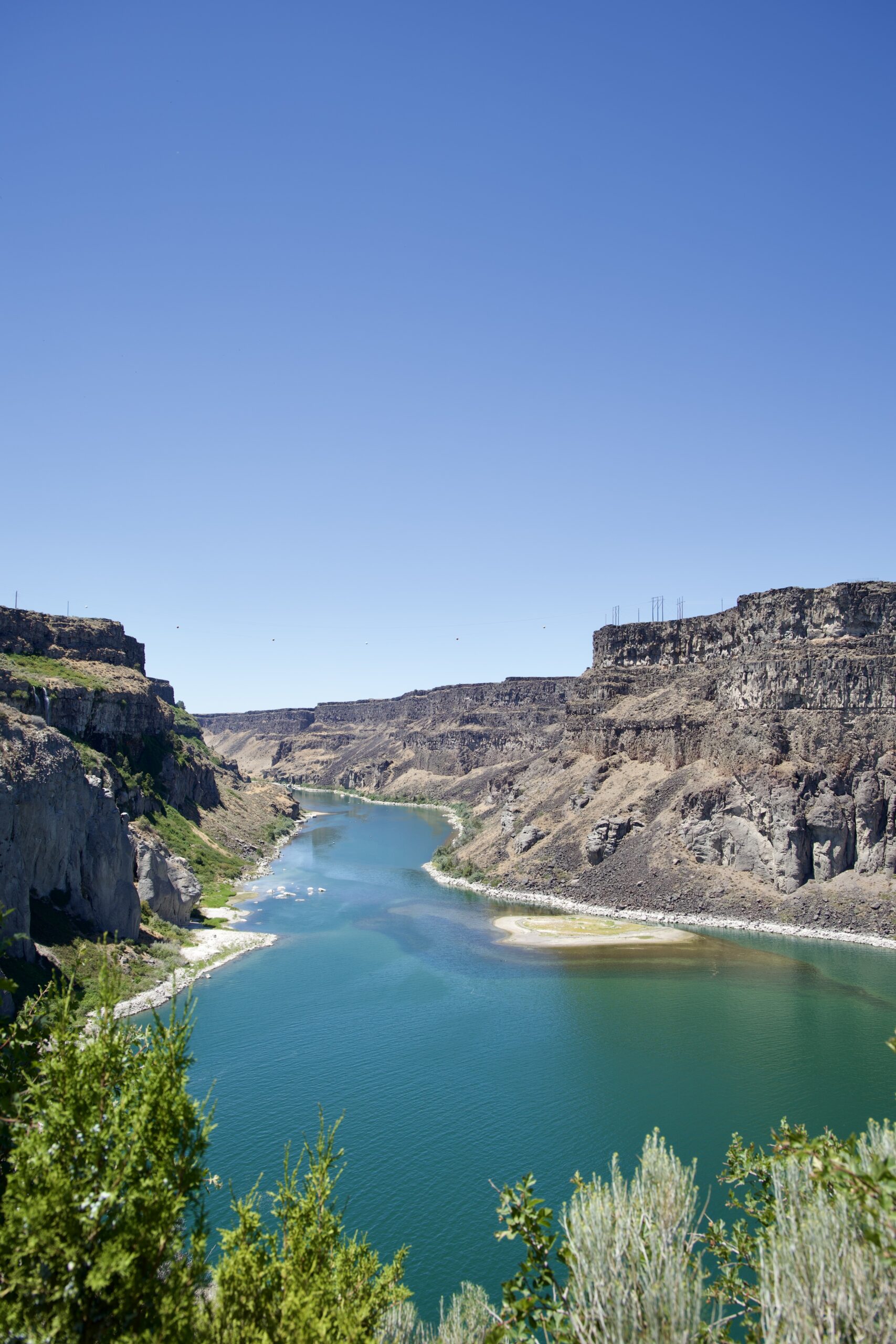
What surprised us most wasn’t the town—it was how much of our time was spent around the river. Nearly every highlight of our trip revolved around the Snake River Canyon, whether we were hiking above it, swimming in it, or simply stopping to admire another incredible viewpoint.
If you’re planning a visit, don’t think of Twin Falls as a city vacation.
Think of it as an outdoor adventure with a comfortable town wrapped around it.
Day One: Shoshone Falls, the Canyon Rim Trail & Dierkes Lake
Our first full day in Twin Falls happened to fall over the Fourth of July weekend.
We knew it would be busy, temperatures were already climbing, and we had a pretty ambitious plan: start at Shoshone Falls, ride the Canyon Rim Trail to Perrine Bridge, cool off at Dierkes Lake, and finish the day with fireworks.
It ended up being one of those days that perfectly captures what Twin Falls is all about—beautiful scenery, plenty of time outside, and a few lessons we’d definitely carry into our next visit.
Our First Stop: Shoshone Fall
We started at Shoshone Falls Park, which charges $5 per vehicle and gives you access to both Shoshone Falls and Dierkes Lake.
One thing we noticed immediately was how different the parking situation was between the two areas.
The Dierkes Lake parking lots were already packed because of the holiday weekend, but the Shoshone Falls side still had plenty of available parking. If you’re visiting during a busy summer weekend, I’d head there first before making your way to the lake later in the day.
Unfortunately, we also learned something that no amount of trip planning can guarantee.
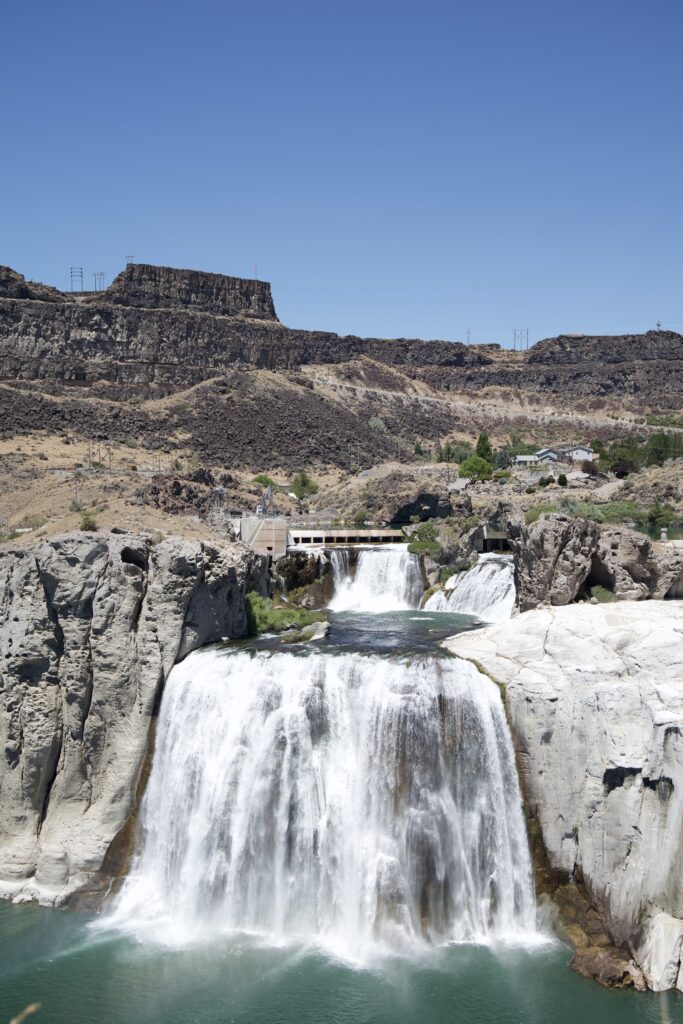
The waterfalls were running very low.
We walked through all of the main overlooks, but compared to the powerful spring photos you’ll often see online, there simply wasn’t much water coming over the falls during our visit. It wasn’t disappointing because the park wasn’t beautiful—it was—but it reminded us that timing matters if Shoshone Falls is the main reason you’re visiting Twin Falls.
If seeing the falls at their most impressive is high on your list, I’d plan your trip for late spring when snowmelt usually creates a much more dramatic display.
💡 Rolling Williams Tip
Don’t judge Shoshone Falls by photos alone. Water flow changes dramatically throughout the year, so check current conditions before planning your visit if the falls are your top priority.
Biking the Snake River Canyon Rim Trail
From Shoshone Falls, we loaded up our e-bikes and headed toward Perrine Bridge along the Canyon Rim Trail.
Our two youngest rode on the back of our electric bikes, while our oldest started the ride on her own bike. The round-trip distance from Shoshone Falls Park and Perrine Bridge ended up being about 8–9 miles.
Here’s where we’ll probably save another family from making the same mistake.
We would not recommend this trail hiking or riding without electric bikes, especially in the summer.
On a map, it doesn’t look particularly difficult.
In reality, the climb toward Perrine Bridge is long, exposed, and much steeper than we expected. There is very little shade along the route, and on a hot July afternoon the heat becomes just as challenging as the distance.
Our oldest eventually shared the distancing switching with her sister because the climb was simply too much.
The ride back toward Shoshone Falls was much easier thanks to the downhill grade, but we all agreed we’d make a different choice next time.
https://www.alltrails.com/trail/us/idaho/snake-river-canyon-rim-trail
Along the Trail
One thing we appreciated was how quiet the trail felt.
Even over a holiday weekend, we rarely felt crowded. That gave us plenty of opportunities to stop for photos and enjoy the canyon without feeling rushed.
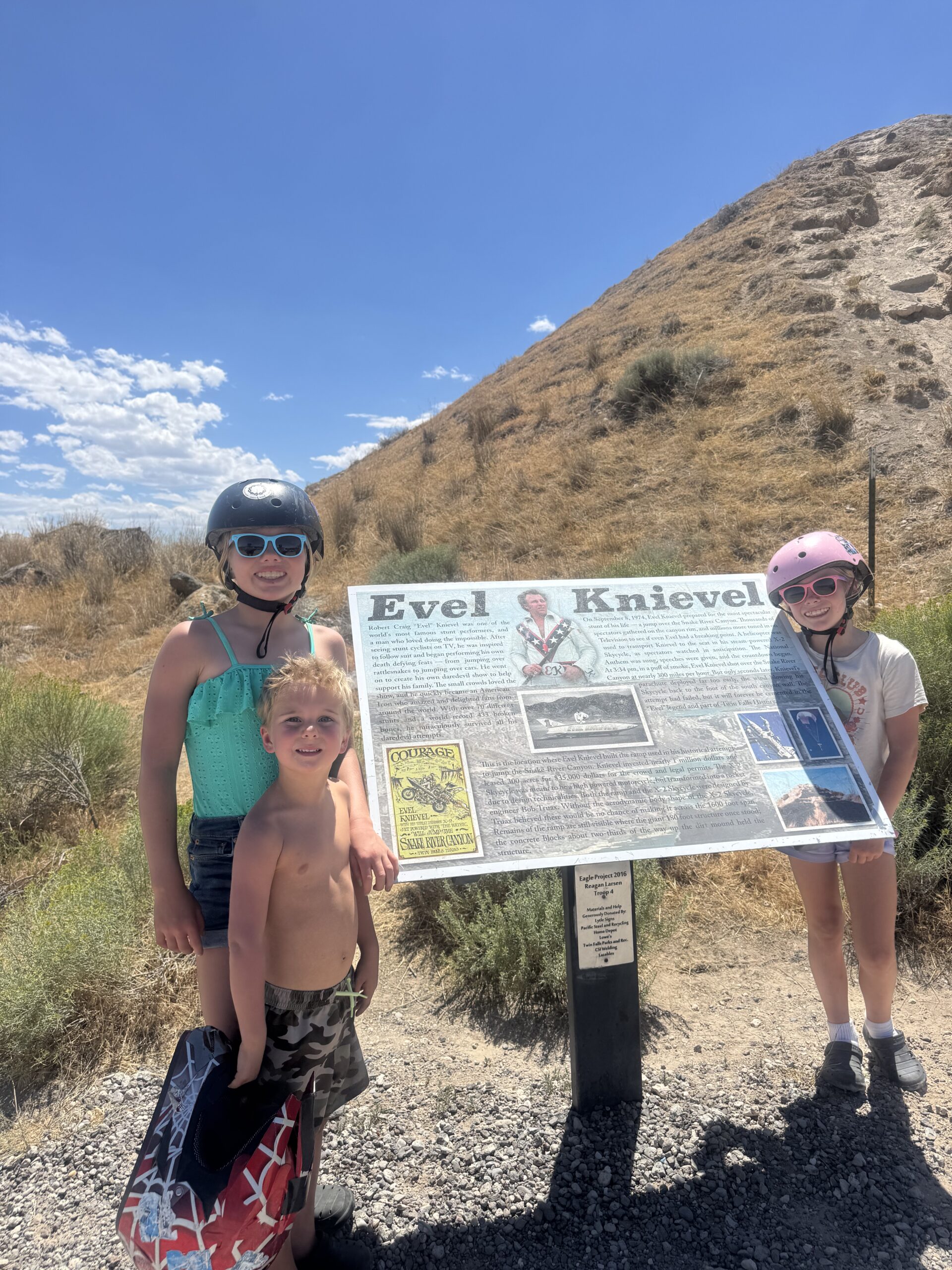
Along the route you’ll also pass the Evel Knievel Jump Site, where informational signs explain his famous attempt to jump the Snake River Canyon in 1974. Even if you’re only vaguely familiar with the story, it’s a worthwhile stop and gives the trail a little extra character.
We also found ourselves admiring some of the homes perched right along the canyon rim. Every few minutes we’d round another corner and wonder what it must be like to wake up to that view every morning.
As we got closer to Perrine Bridge, one thing became increasingly obvious.
We were getting thirsty.
There are very few opportunities to refill water along the trail, making the Perrine Bridge Visitor Center the first real chance to grab a drink, use the restroom, or step inside for a few minutes out of the sun.
Perrine Bridge
By the time we reached Perrine Bridge, there was a small crowd gathered beneath the limited shade near the visitor center.
Some people were watching BASE jumpers launch themselves into the canyon below, while others simply enjoyed escaping the afternoon sun.
Because we visited during America’s 250th birthday celebration, there was something especially memorable waiting for us.
Suspended across the Snake River Canyon was The Patriot, one of the largest free-flying American flags in the United States.
Seeing a flag that enormous stretched across the canyon was something none of us expected, and it added an unforgettable backdrop to an already iconic viewpoint. Combined with the bridge itself, the canyon, and the occasional BASE jumper floating below, it created one of the most memorable scenes of our entire visit.
Cooling Off at Dierkes Lake
After several hours in the sun, we were ready for one thing.
Cold water.
We headed back to Dierkes Lake, and despite the holiday crowds, it ended up being one of our favorite stops of the day.
The park has a large grassy area with plenty of room to spread out, picnic tables, restrooms, a designated swimming area, a diving board, and easy access for kayaks and paddleboards beyond the swimming zone.
The water was surprisingly clear.
Even with the beach full of families, it still felt clean, refreshing, and inviting. The lake has shallow areas where younger kids can comfortably play, but there are also deeper sections and rocks that older kids and adults were jumping from throughout the afternoon.
After biking in the heat, it was exactly what we needed.
💡Family Notes
- Great place to cool off after hiking or biking.
- Clean restrooms and plenty of grass for a picnic.
- Good mix of shallow water and deeper swimming areas.
- Very family-friendly, even on a busy holiday weekend.
- Expect crowds if you’re visiting during the Fourth of July.
Ending the Day
We wrapped up the evening at the College of Southern Idaho for the Fourth of July fireworks.
After spending the entire day outside, sitting together on the grass watching fireworks felt like the perfect ending.
The show was excellent, the atmosphere was relaxed, and despite the holiday, it never felt overwhelmingly crowded. Families were spread out across the grounds, kids played while they waited for the show to start, and it was one of those simple evenings that reminds you why you travel in the first place.
Not every great memory comes from a famous attraction.
Sometimes it’s just ending a long day together under a summer sky.
Day Two: Box Canyon, Swimming in One of Idaho’s Most Beautiful Springs & Malad Gorge
If our first day was about seeing Twin Falls’ most famous landmarks…
Our second day was about discovering the place we’ll remember most.
If you only have time for one hike in the Twin Falls area, this would be our pick.
Not because it’s the easiest.
Not because it’s the most famous.
But because it combines an incredible overlook, a beautiful hike, a roaring waterfall, and one of the most breathtaking swimming holes we’ve ever experienced—all in one outing.
Just don’t underestimate it.
Especially in the summer.
https://parksandrecreation.idaho.gov/state-park/thousand-springs-state-park/
Finding Box Canyon
One of the first things that surprised us about Box Canyon was getting there.
Unlike Shoshone Falls or Perrine Bridge, Box Canyon doesn’t feel like a major tourist attraction.
The drive winds through quiet farmland, and for a while we honestly wondered if our GPS had taken us the wrong way. Then suddenly, tucked away among the fields, we found the entrance to Box Canyon Springs Preserve.
Parking was easy, even on a summer weekend.
It costs $7 per vehicle, but that admission also covers every unit of Thousand Springs State Park for the rest of the day, making it one of the better values we found during our trip.
There are restrooms at the trailhead, and before you even start hiking, you’ll get your first look into the canyon.
Standing at the overlook, it’s hard not to get excited.
The water below is an unreal shade of blue, the canyon walls seem to drop straight down, and suddenly everyone in your group is ready to start hiking—even on another hot July afternoon.
https://www.alltrails.com/trail/us/idaho/box-canyon-springs-trail
💡 Rolling Williams Tip
Pay the entrance fee early in the day and keep your receipt. It’s valid at the other Thousand Springs State Park units, including Malad Gorge and Ritter Island, for the rest of the day. If you buy a pass at the trailhead you have to have CASH but they accept cards at the Visitor Center so plan ahead.
The Hike Down
The trail begins on what feels more like a dusty ranch road than a hiking trail.
You can follow the main path, but we’d actually recommend staying closer to the canyon rim whenever possible. The views are better, and you’ll naturally find yourself stopping for photos.
Before long you’ll reach a sign that reads:
“Caution: Unimproved Trail. Use at Your Own Risk.”
That’s your turn.
From there, the trail drops steeply into the canyon.
It looks intimidating at first, but we thought it was much more manageable than expected.
The descent is sandy with some uneven footing and a little rock scrambling, but our entire family—including our four-year-old and our dog, Willie—handled it without any problems.
There are handrails in a few places, but we rarely felt like we needed them.
I wore Earth Runners and managed just fine, but if we were doing it again, I’d probably wear trail shoes or water shoes for a little extra grip.
Family Notes:
- Our 4, 9, and 11-year-olds all completed the hike.
- Willie loved it, although he did get stung or bitten by something along the trail. Thankfully, he was completely fine after a few minutes.
- Confident young hikers shouldn’t have any trouble, but keep a close eye on little ones during the descent.
Summer Is No Joke
If you’re visiting during the summer, plan accordingly.
There is very little shade on the way down, and the Idaho sun is intense.
Bring:
- A hydration pack for every person
- Sunscreen
- Hats
- Swimsuits
- Goggles
- More water than you think you’ll need
We carried two 1.5-liter hydration packs for our family, and by the hike back out we were carefully rationing what we had left.
If we did this again, every person would carry their own water.
The Waterfall
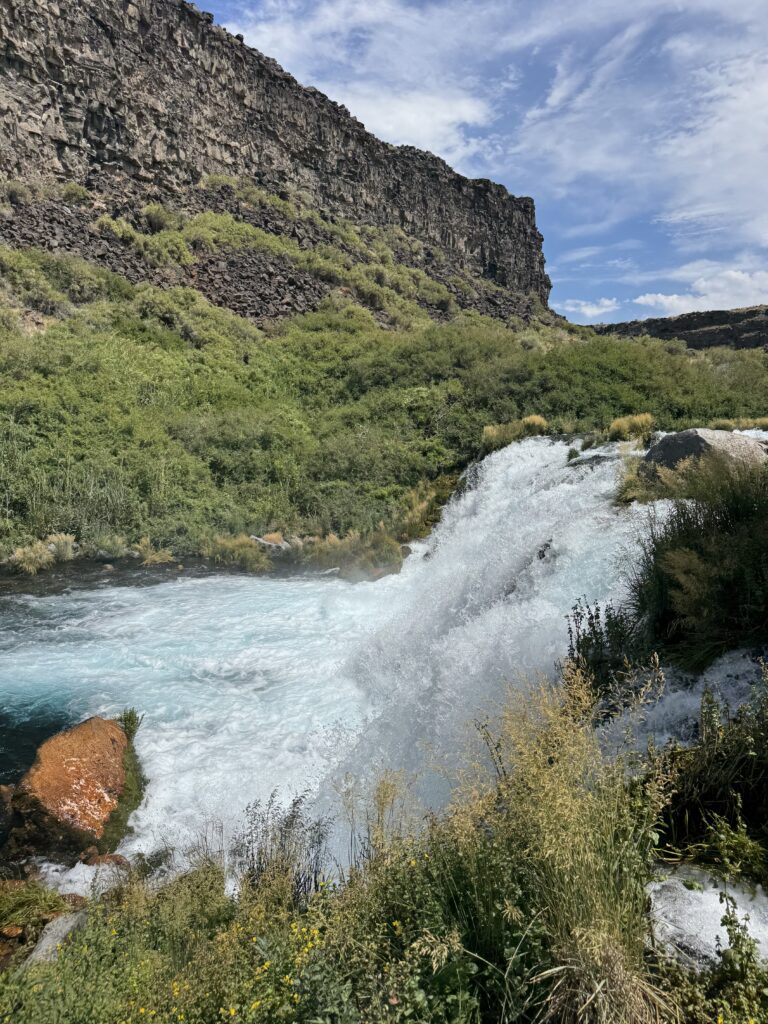
As you continue along the canyon floor, everything starts to change.
The trail becomes greener.
The temperatures cool slightly.
Trees begin providing welcome shade.
The sound of rushing water grows louder with every step.
Then suddenly…
You reach the waterfall.
It absolutely roars.
The overlook photos are beautiful, but they don’t prepare you for standing beside it.
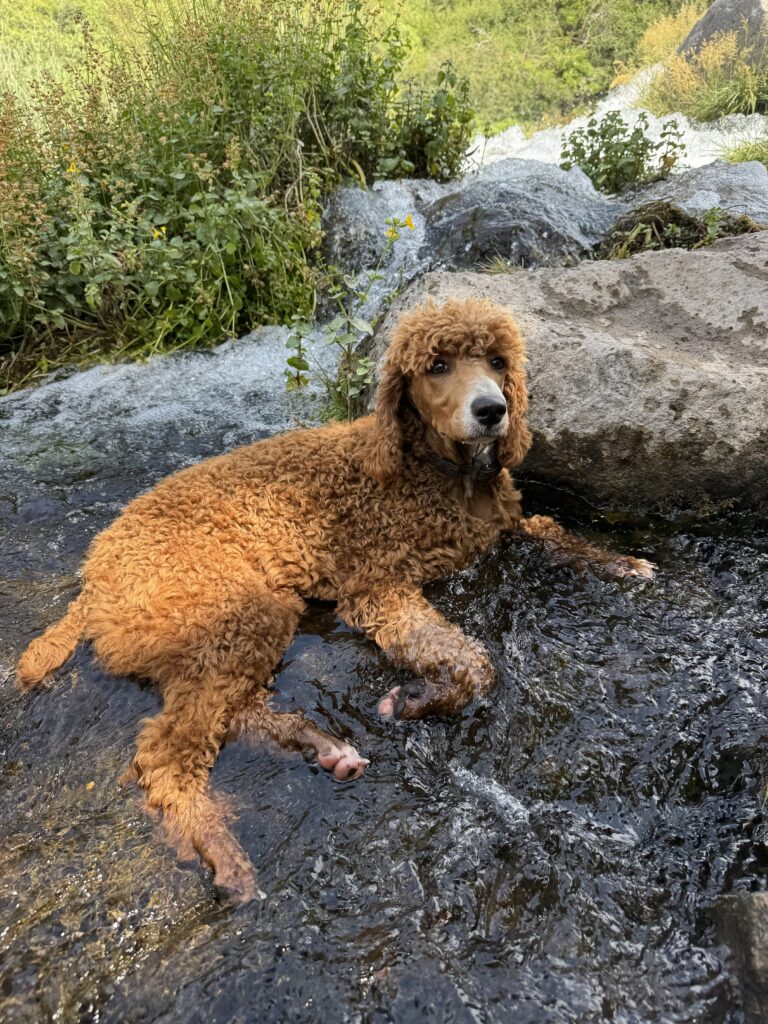
Willie immediately found a shallow pool where he happily laid down to cool off while drinking from the cold spring water.
It ended up being one of those little moments we’ll probably remember just as much as the waterfall itself.
The trail narrows considerably here, so passing other hikers takes a little patience, but everyone we encountered was friendly and happy to share the path.
One thing to be aware of…
We noticed quite a bit of poison oak, plenty of stinging nettles, and more ants than we expected.
They’re easy enough to avoid if you’re paying attention, but it’s definitely something families—and especially dog owners—should know before heading down.
💡 Rolling Williams Tip
Keep an eye on kids and dogs near the edges of the trail where poison oak grows. It’s easy to avoid, but only if you’re watching for it.
The Swimming Hole
Then came our favorite part of the entire Twin Falls trip.
After crossing the bridge, take the trail to the left.
A few minutes later you’ll arrive at the swimming area.
Pictures don’t really prepare you for it.
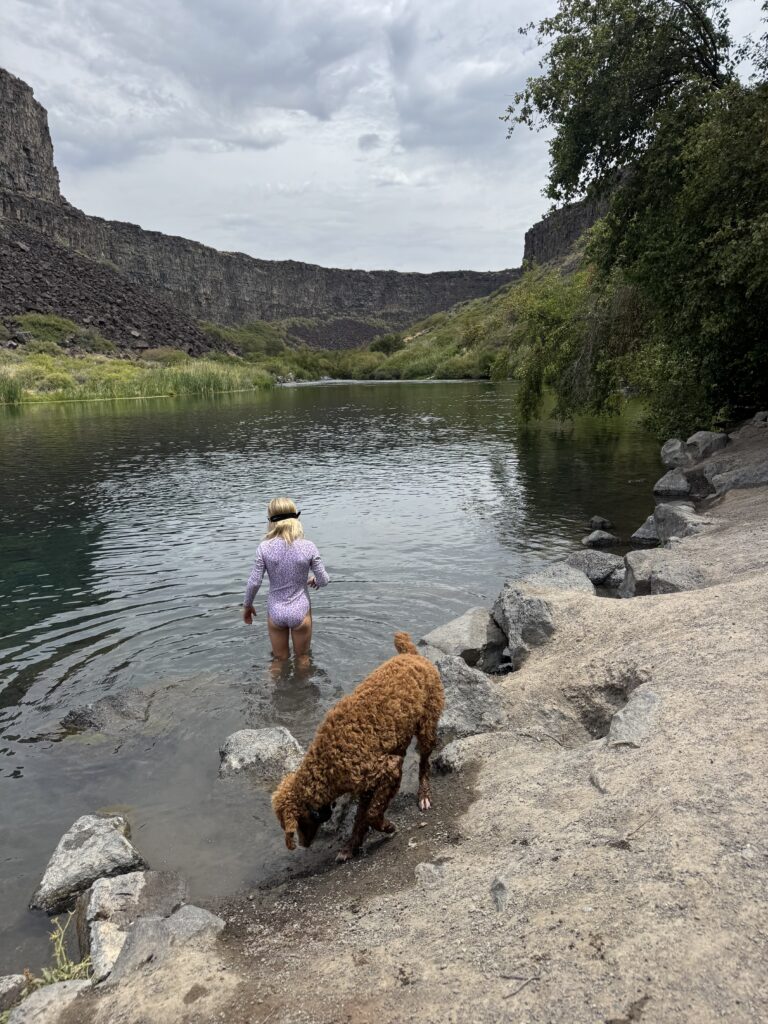
The spring is unbelievably clear, impossibly blue, and surrounded by towering canyon walls that make it feel hidden away from the rest of the world.
The water is cold.
Really cold.
But after hiking in the July heat, jumping in felt incredible.
The edges are shallow enough for kids to splash and play, while the center quickly drops into deep, crystal-clear water.
Bring goggles.
Seriously.
Looking beneath the surface and seeing schools of fish gliding through the water was one of the coolest parts of the entire experience.
It’s the kind of detail we’d have completely missed without them.
There were only a handful of families swimming while we were there, several friendly dogs playing together, and even a portable restroom nearby.
It somehow felt both peaceful and lively at the same time.
One of my favorite memories wasn’t even the scenery.
It was meeting another family whose dog instantly became friends with Willie.
Travel has a funny way of reminding you that people from completely different places often have far more in common than we realize.
Those small conversations with strangers are some of my favorite souvenirs.
Hiking Back Out
Eventually we packed everything up and started the climb back out of the canyon.
The uphill hike is definitely more strenuous than the descent, but it’s short enough that we never felt overwhelmed.
One thing we wouldn’t do again?
The remainder of the loop trail.
We continued just long enough to realize it added very little to the experience before heading back toward the parking area.
If we came back, we’d simply retrace our steps through the canyon.
The views are better, and you’d rather spend that extra time swimming.
An Afternoon at Malad Gorge
After spending most of the day at Box Canyon, we didn’t have enough time left for Ritter Island.
Instead, we stopped at the Thousand Springs Visitor Center, picked up a magnet, stamped our National Park Passport book, and grabbed Junior Ranger booklets for the kids.
The rangers were incredibly friendly and helped us better understand how all of the different Thousand Springs units fit together—something that honestly confused us while planning the trip.
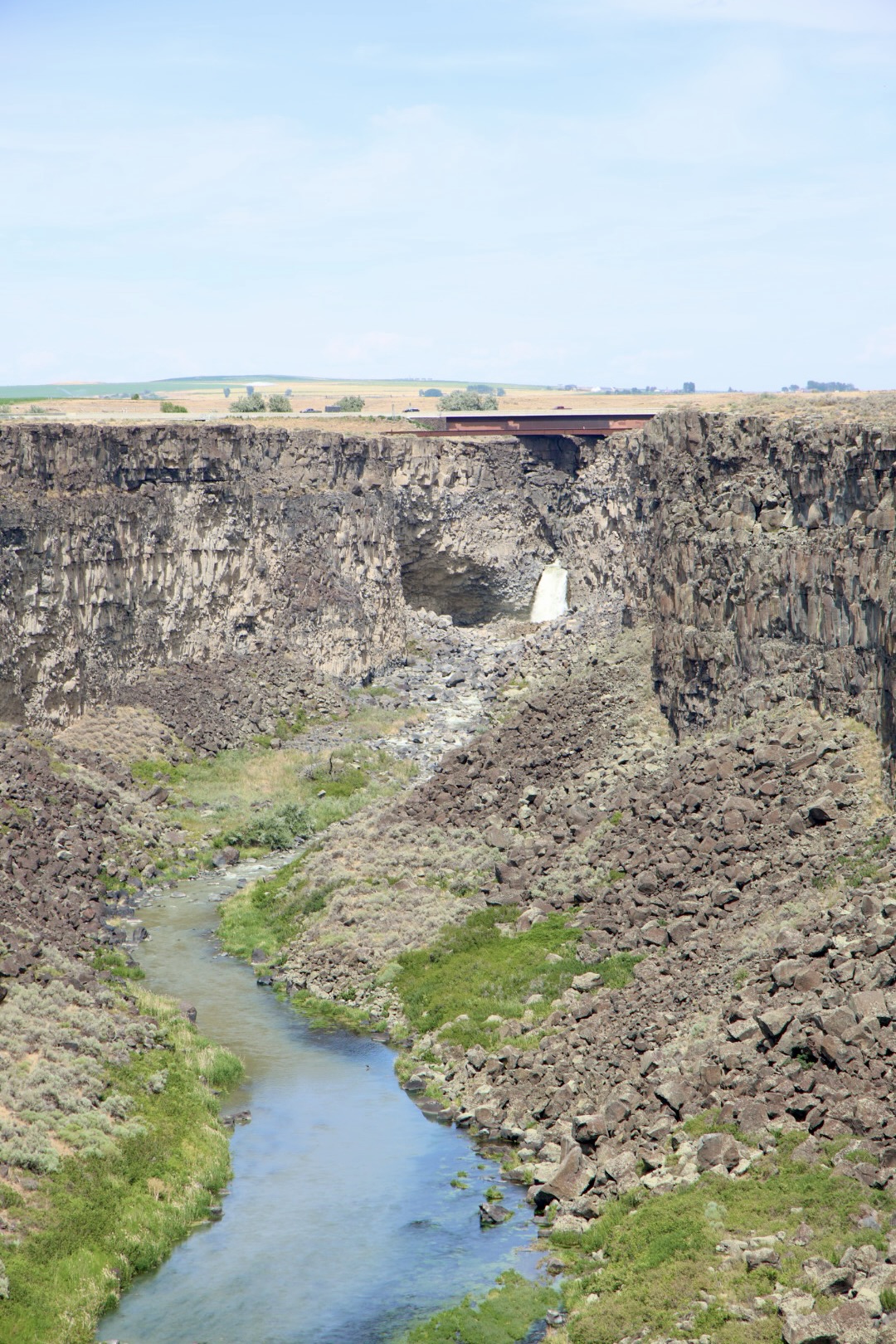
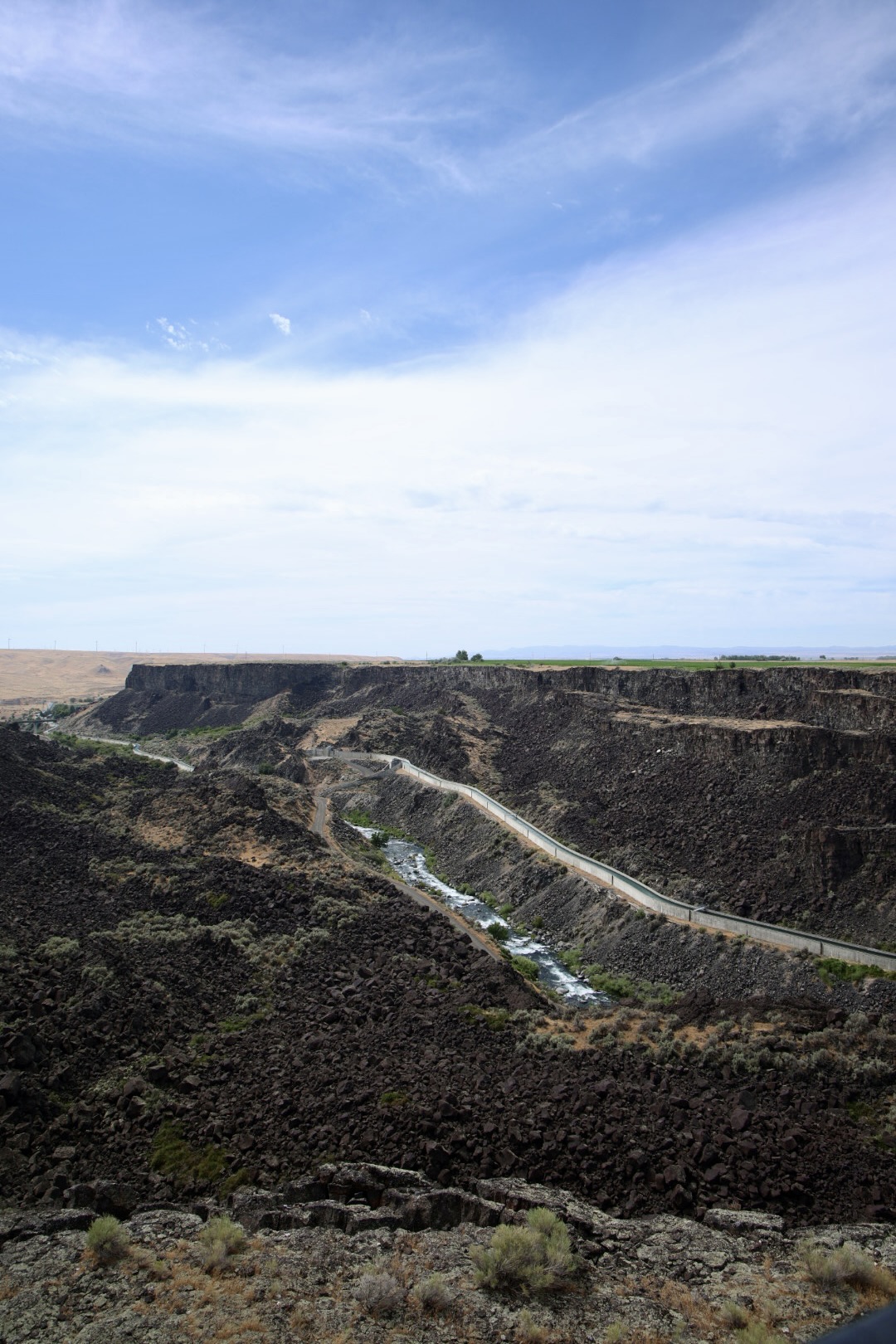
From there we drove through Malad Gorge State Park.
The gorge itself is impressive, and my husband especially enjoyed seeing the historic water diversion structures and engineering behind them.
Devil’s Washbowl, however, didn’t leave much of an impression on us.
If you’re already visiting Malad Gorge, it’s worth stopping for a few minutes.
But if you’re trying to prioritize your time, we wouldn’t build an entire day around seeing it.
By the end of the afternoon we were sunburned, tired, dusty, and completely worn out.
It had been one of those full adventure days where everyone falls asleep almost as soon as their head hits the pillow.
And honestly…
Those usually end up being the best ones.
If We Only Had One Day in Twin Falls
If someone told us we only had one full day in Twin Falls, we’d skip trying to cram everything in. Instead, we’d focus on the experiences we enjoyed the most.
Morning
Start early at Box Canyon before the summer heat settles into the canyon. Hike down, spend time exploring the waterfall, and don’t rush through the swimming hole. This was easily our favorite experience of the trip.
Afternoon
Drive to Perrine Bridge, watch the BASE jumpers if they’re out, spend a little time at the visitor center, and enjoy the views over the Snake River Canyon.
If it’s hot—and it probably will be during the summer—finish the afternoon swimming at Dierkes Lake.
If We Had Two Days
Two days is what we’d recommend for most families.
Day One would stay almost exactly the same.
Day Two would be dedicated almost entirely to Box Canyon and Thousand Springs State Park.
We wouldn’t rush.
One of our biggest mistakes was underestimating how much time we’d want to spend swimming once we reached Box Canyon.
Instead of trying to check off every Thousand Springs unit, we’d accept that Box Canyon deserves several hours by itself.
Then, if time allows, we’d finish with Malad Gorge before heading back for dinner.
If We Had One More Day
This is where we’d spend our extra time. Without question.
Blue Heart Springs
This is the biggest thing we wish we’d experienced.
Every person we talked to recommended it, and after seeing more of the Snake River, we’re convinced it would have been one of the highlights of the trip.
Ritter Island
We also wish we’d spent more time exploring Ritter Island.
By the end of our Box Canyon adventure, we simply ran out of energy—and honestly, we think that’s okay.
Sometimes leaving a place with something still left to discover is a good reason to come back.
What We’d Skip Next Time:
We probably wouldn’t…
Bike the entire Canyon Rim Trail again in the middle of summer.
We enjoyed it. But we’d rather spend that time swimming or hiking somewhere else.
Complete the Box Canyon loop. The return hike through the canyon is simply more enjoyable.
Plan a special trip just for Devil’s Washbowl. It’s worth stopping if you’re already visiting Malad Gorge, but it wouldn’t be one of the highlights we’d build an itinerary around.
Who We Think Will Love Twin Falls
Twin Falls is a great fit if you…
✔️ Love being outside.
✔️ Have active kids.
✔️ Enjoy hiking and swimming in the same day.
✔️ Like bringing your dog on adventures.
✔️ Are traveling through southern Idaho and want to spend two or three days exploring.
✔️ Enjoy places that feel a little less touristy than major national parks.
You might enjoy another part of Idaho more if…
✔️ You’re hoping for towering mountain scenery.
✔️ You’re planning your one “bucket list” Idaho vacation.
✔️ You don’t enjoy extreme summer heat.
✔️ You prefer scenic drives over active outdoor adventures.
If We Came Back Tomorrow…
We’d head straight back to Box Canyon. We’d each carry our own hydration pack, pack goggles without a second thought, and plan to spend even more time swimming in that unbelievably clear spring. We’d skip biking the entire Canyon Rim Trail in the summer heat and simply drive between Shoshone Falls and Perrine Bridge. We’d finally paddle Blue Heart Springs, explore Ritter Island, and still make time to train at Alliance Twin Falls before leaving town.
Twin Falls probably wouldn’t be the first place we’d recommend if someone asked us to pick one destination in Idaho. But we’re really glad we came.
This trip reminded us that not every memorable place has to be the biggest, the most famous, or the most dramatic. Sometimes the best memories come from cooling off in a spring after a hot hike, watching your dog make a new friend, seeing your kids jump into freezing water without hesitation, or ending a long day exhausted in the best possible way.
If your family enjoys staying active, doesn’t mind getting a little dusty, and loves finding adventure wherever you are, we think there’s a good chance you’ll leave Twin Falls feeling the same way we did.
Our job isn’t to tell you where to go. It’s to help you decide where you’ll be glad you went.
For us, Twin Falls was absolutely one of those places.
Continue Planning Your Trip
If you’re visiting Twin Falls, these guides may help you plan the rest of your stay.
Where We Stayed:
Oregon Trail Campground Review
Read our full review of Oregon Trail Campground, including site quality, cleanliness, amenities, and whether we’d stay there again.
Where We Trained:
Alliance Twin Falls Review
Everything you need to know before dropping in, including kids classes, coaching, gym culture, and who we’d recommend it for.
Planning Your Next Stop?
Explore our other destination guides:
- Bend, Oregon
- Glacier National Park
- Arco, Idaho
- Spokane, Washington